Why You Must Send Lease Notices via Certified Mail
Team LeaseTerminationLetter
·Published
Quick Answer
You must send lease notices via USPS Certified Mail because it provides a legally recognized "proof of service." The sender receives a tracking number showing exactly when delivery was attempted, and the Return Receipt (the green card) provides the physical signature of the recipient. This prevents landlords or tenants from claiming they never received the notice.
When it comes to renting property, documentation is everything. Whether you are a tenant terminating a month-to-month lease, a landlord issuing a notice to cure or quit, or someone invoking military protections under the SCRA, the content of your letter is only half the battle. If you cannot definitively prove that the other party received your notice, your legal standing collapses. The "I never got the letter" defense is the oldest trick in the book. To protect yourself from costly legal disputes, lost security deposits, and drawn-out evictions, you must understand why sending lease notices via USPS Certified Mail with a Return Receipt is the absolute gold standard in real estate law.
What is USPS Certified Mail?
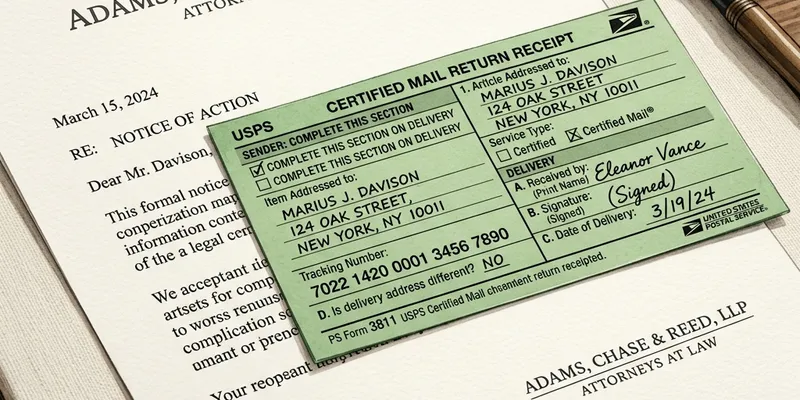
USPS Certified Mail is a special service offered by the United States Postal Service that provides the sender with a mailing receipt and electronic verification that an article was delivered or that a delivery attempt was made. When you combine this with the "Return Receipt" add-on service, USPS provides you with a physical green card (or an electronic equivalent) containing the actual signature of the person who received the mail, the date of delivery, and the delivery address.
This service transforms a standard piece of mail into a highly tracked, legally formidable document. It removes the ambiguity of standard mail delivery and shifts the burden of proof off of the sender and onto the recipient.
The Legal Concept of "Proof of Service"
In the legal world, it does not matter what you say happened; it only matters what you can prove happened in court. "Proof of Service" is a legal term referring to the confirmation that a party was properly provided with a required legal document (like a lease termination letter).
State laws are extremely strict regarding how much notice a landlord or tenant must give to terminate a lease—often 30 or 60 days. The countdown for that notice period does not begin when you write the letter, nor when you drop it in a mailbox. The countdown begins when the recipient is legally served. By using Certified Mail with a Return Receipt, you obtain timestamped, court-admissible evidence proving exactly when the notice period began. If a dispute arises over a security deposit or unpaid rent, presenting a signed green card to a judge immediately shuts down the opposing party's argument.
Certified Mail vs. Regular Mail
Many tenants make the critical error of dropping their notice in a standard blue USPS mailbox with a regular stamp. This is highly risky. Regular First-Class Mail offers zero tracking. If a landlord wants to wrongfully keep your security deposit by claiming you did not provide the mandatory 30-day notice, they will simply say, "I never got it."
At that point, it becomes a "he-said, she-said" argument, and courts generally require the party who sent the notice to prove it was delivered. Without a tracking number or a signature, you have no evidence. The landlord wins. Spending a few extra dollars on Certified Mail guarantees you will not be held hostage by the "lost in the mail" excuse.
Certified Mail vs. Email and Text Messages
We live in a digital age where communicating with your landlord or property manager via email, text message, or an online tenant portal is the norm. It seems entirely logical to send your termination notice the same way. However, you must fight this urge.
Unless your specific lease agreement contains a clearly defined "Electronic Notice Clause" that explicitly permits legal notices to be served via email, courts in most states do not recognize emails or texts as valid forms of lease termination. Even if your landlord responds to your email, a strict judge might still rule that your notice was legally defective because it didn't follow statutory requirements. Always default to physical, Certified Mail. If you wish to send an email as a courtesy heads-up, that is fine, but state in the email: "A formal, hard copy of this notice has also been sent via USPS Certified Mail."
Step-by-Step: How to Send a Certified Letter
Sending a Certified Letter is straightforward, though it does require a physical trip to the post office. You can learn more about USPS Certified Mail services at USPS.com. Follow these steps:
- Draft and Sign: Write your lease termination letter, sign it in ink, and make a photocopy for your own records.
- Go to USPS: Take the sealed envelope to your local post office.
- Fill out Form 3800: This is the green and white Certified Mail receipt. It provides your tracking number.
- Fill out Form 3811: This is the green Return Receipt card. You attach this to the back of the envelope. The postal worker will have the recipient sign this card upon delivery, and USPS will mail the card back to you.
- Keep Your Receipts: File the initial mailing receipt (Form 3800) safely with your copy of the letter. Once the green card (Form 3811) arrives in your mail a few days later, staple it to your file.
What Happens if They Refuse to Sign?
Occasionally, a difficult landlord or evasive tenant will see the green Certified Mail tag and refuse to sign for the letter, thinking that if they don't sign it, they haven't been legally notified. This is a myth.
The legal system is aware of this tactic. If a recipient deliberately refuses delivery, courts apply the doctrine of "constructive receipt." This means that because you made a demonstrable, verifiable attempt to deliver the legal document, the court considers it effectively delivered. Your USPS tracking history will show "Delivery Attempted - Refused." That tracking status, combined with a backup copy of the letter sent via regular First-Class mail, is all the proof you need to win your case.
Generate Your Letter Ready for Mailing
Before you head to the post office, make sure your letter contains all the legally required phrasing. Use our free tool to generate a state-specific lease termination letter instantly.
Create Your Free Letter →Frequently Asked Questions (FAQs)
What happens if my landlord refuses to sign for the Certified Mail?
If a landlord deliberately refuses to sign for or accept Certified Mail, most courts consider the notice effectively delivered under the doctrine of "constructive receipt." As long as you have the USPS tracking information showing the delivery attempt and refusal, you have met your legal obligation to provide notice.
Are emails legally binding for lease termination?
In most states, email is not considered a legally binding method for delivering lease termination notices unless your lease agreement explicitly includes an electronic communication clause permitting it. Always default to Certified Mail to ensure full legal compliance.
How much does USPS Certified Mail with a Return Receipt cost?
The cost typically ranges from $7 to $9. This includes the standard postage fee, the Certified Mail fee (around $4.40), and the Return Receipt fee (around $3.65 for a hard copy green card or $2.30 for an electronic receipt). Rates are subject to change by USPS.
Should I send a copy via regular mail as well?
Yes, it is highly recommended to send one copy via Certified Mail and a second identical copy via regular First-Class Mail. If the recipient avoids the Certified Mail, the regular mail delivery helps prove they still received the notice.
Related Articles
- How to Write a Legally Valid Lease Termination Letter
Ensure your letter has all required elements before mailing it.
- 30-Day vs 60-Day Lease Termination Notice
Know exactly when to send your certified letter based on your state's requirements.
- Early Lease Termination Letter: When and How to Break Your Lease
Complete guide for breaking a lease early — all letters should be sent certified.