A Professional Template for Landlord Lease Termination Notices
Team LeaseTerminationLetter
·Published · Updated
Quick Answer
A landlord lease termination notice must include the tenant's full legal name and address, the complete property address, the exact termination/move-out date, the legal basis for termination, and a citation to the applicable state statute. Landlords often face stricter notice requirements than tenants — many states require landlords to provide 60 days' notice for long-term tenants, while tenants only need 30 days.
As a landlord, managing your rental property portfolio effectively means knowing how to end tenancies professionally and legally. Whether you are dealing with a difficult tenant, planning to sell the property, deciding to move into the unit yourself, or simply choosing not to renew a month-to-month agreement, issuing a proper lease termination notice is the required first step. A poorly drafted notice can lead to messy legal disputes, delayed move-outs, and significant financial losses. In this comprehensive guide, we will provide you with a professional template for landlord lease termination notices, explain the critical legal elements you must include, and discuss how to properly serve the notice to ensure it holds up in a court of law.
What Is the Difference Between Termination and Eviction?
Many property owners confuse lease termination notices with eviction notices, but they serve entirely different legal purposes. A lease termination notice is simply a declaration that a lease agreement is coming to its natural end, or that a month-to-month tenancy is being canceled. It does not imply that the tenant has done anything wrong. It is a standard administrative procedure.
An eviction notice (such as a 3-Day Notice to Pay or Quit, or a Notice to Cure), on the other hand, is an adversarial legal document used when a tenant has breached the contract—such as by failing to pay rent, bringing in unauthorized pets, or conducting illegal activities on the premises. Evictions are legal proceedings; terminations are standard contract conclusions. If a tenant fails to leave after a termination notice expires, they become a holdover tenant, and then you must begin the eviction process.
When Should a Landlord Use a Lease Termination Notice?
You should use a lease termination notice in the following scenarios:
- Ending a Month-to-Month Lease: Most states allow landlords to terminate month-to-month leases with 30 or 60 days' notice for any non-discriminatory reason.
- Non-Renewal of a Fixed-Term Lease: If a tenant's one-year lease is approaching its end and you do not wish to renew it, you must send a notice (usually 30 to 60 days prior to the expiration date) stating that the lease will end on the specified date and will not convert to a month-to-month agreement.
- Selling the Property: If you are selling the property and the new owner wants it vacant, you must terminate the leases of any month-to-month tenants prior to closing.
- Owner Move-In: If you or a direct family member intend to move into the unit.
What Must a Landlord's Notice Include?
To ensure your notice is legally binding and protects you from tenant lawsuits or delays in court, it must include the following information:
- Current Date: The exact date the letter is written and served.
- Tenant Information: The full legal names of all adult tenants listed on the lease agreement.
- Property Address: The complete address of the rental unit, including apartment or unit numbers.
- Clear Statement of Intent: An unambiguous declaration that the lease is being terminated and will not be renewed.
- Move-Out Deadline: The specific date and time by which the tenant must have removed all personal belongings and vacated the premises (e.g., "by 11:59 PM on August 31st").
- Move-Out Instructions: Details regarding the final walk-through inspection, key return procedures, and a request for the tenant's forwarding address for the security deposit return.
- Landlord Signature: Your physical signature, printed name, and contact information.
The Professional Landlord Template
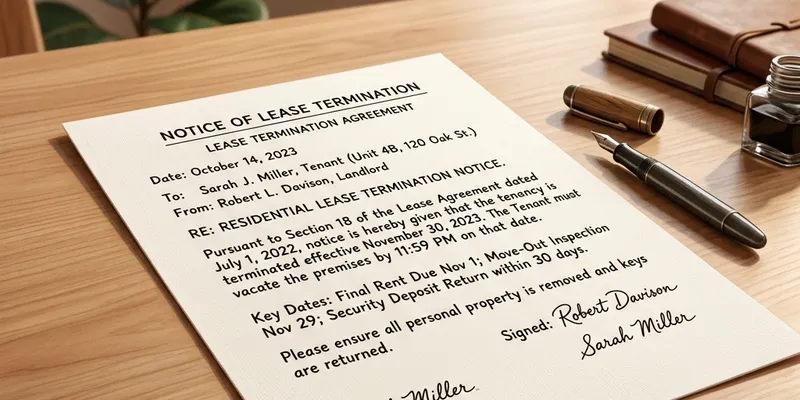
Below is a standard, professional template you can adapt for your needs. Be sure to fill in the bracketed information with your specific details.
[Date]
To: [Tenant Name(s)]
Address: [Full Property Address]
Re: Notice of Lease Termination and Non-Renewal
Dear [Tenant Name(s)],
Please accept this letter as formal written notice that your lease agreement for the property located at [Full Property Address] will be terminated effectively on [Termination Date]. Your current lease expires on this date, and this letter serves as official notification that the lease will not be renewed.
You are required to vacate the premises, remove all of your personal property, and return all keys by [Time, e.g., 5:00 PM] on [Termination Date]. If you fail to vacate the property by this deadline, legal action may be taken to recover possession of the property, and you may be held liable for damages as a holdover tenant.
We will need to schedule a final walk-through inspection of the property. Please contact me at [Your Phone Number] or [Your Email] to arrange a convenient time for this inspection prior to your move-out date.
Additionally, please provide a forwarding address so that your security deposit, minus any lawful deductions for damages or unpaid charges, can be returned to you in accordance with state law.
Thank you for your tenancy and cooperation in this matter.
Sincerely,
[Your Signature]
[Your Printed Name]
[Your Contact Information]
How Should You Deliver a Lease Termination Notice?
Even the most perfectly drafted template is useless if you cannot prove the tenant received it. Do not rely on a text message or a phone call. To ensure your notice is legally recognized, you must serve it properly.
We strongly advise sending the notice via USPS Certified Mail with a Return Receipt. This provides a paper trail and a physical signature from the tenant proving they received the document. Alternatively, in some jurisdictions, personal delivery (handing it directly to the tenant) with a signed acknowledgment of receipt, or posting it conspicuously on the front door of the unit and mailing a backup copy, is acceptable. Always review your specific state statutes to confirm the legally approved methods of service in your area.
Automate Your Legal Notices
Why risk a formatting error or a missed legal requirement? Use our free tool to generate a state-specific, legally bulletproof lease termination notice tailored specifically for landlords.
Generate Landlord Notice →Frequently Asked Questions (FAQs)
Is a lease termination notice the same as an eviction notice?
No. A lease termination notice simply informs the tenant that their lease will not be renewed and they must vacate by the end of the term. An eviction notice (like a Pay or Quit notice) is used when a tenant has violated the lease agreement and the landlord is initiating legal action.
How much notice must a landlord give?
It depends on the state and the lease type. Month-to-month leases usually require 30 to 60 days' notice. If the tenant has lived in the property for over a year, some states (like California) require 60 days' notice.
Do I need to give a reason for not renewing a lease?
In most standard jurisdictions, landlords do not need to provide a reason for terminating a month-to-month lease or choosing not to renew a fixed-term lease. However, in "just cause" eviction jurisdictions, you must state a legally approved reason.
What happens if the tenant doesn't leave?
If a tenant remains in the property after the termination date specified in the notice, they become a "holdover tenant." At that point, you must file a formal eviction lawsuit (unlawful detainer) in court to have them legally removed.